Warning: is_file(): open_basedir restriction in effect. File(/var/www/virtual/agenda2029.es/spainonline.com/stage/htdocs/sites/all/modules/i18n/i18n_object.inc) is not within the allowed path(s): (/var/www/virtual/agenda2029.es/spainonline.com/htdocs:/var/www/virtual/agenda2029.es/phptmp:/usr/share/php/:/var/www/helpers/:/dev/random:/dev/urandom) in Drupal\xautoload\ClassLoader\AbstractQueuedCachedClassLoader->loadClass() (line 82 of /var/www/virtual/agenda2029.es/spainonline.com/htdocs/sites/all/modules/xautoload/src/ClassLoader/AbstractQueuedCachedClassLoader.php).
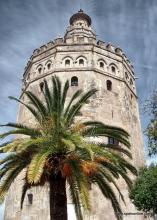
The Gold Tower of Sevillle was one of the last contributions from the Almohade period in Seville. It formed part of the last wall of defence that ran from the Alcázar Palace to the river.
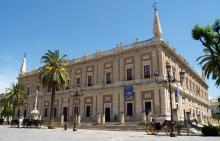
The construction of this building began in the 16th century to be used by traders for their commercial transactions. In 1785, the premises became the headquarters for the General Archives of the Indieswhen structural changes were made to accomodate the numerous files and documents. The archives of the Indies contain references to Spain and her foreign possesions between the 15th and 19th centuries.
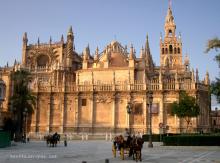
'Let us build a church so big that those who see it will think us mad', that is what the cathedral chapter decided in 1401 when the former mosque of Seville had to be knocked down. It is one of the last Spanish Gothic cathedrals, and the Renaissance style is already evident there. Its impressive size makes it the third largest in the Christian world, after Saint Peter's in Vatican city and Saint Paul's in London.
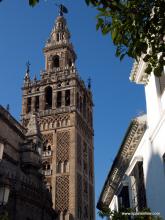
The Giralda is the most emblematic monument of Seville. This Minaret, 76m in height, originally was constructed by the Moors between 1184 and 1197. After the reconquest in 1568 the Christians fitted the minaret with the bell tower. As an emblem of Seville the Giralda forms an elegant and tall silhouette next to the Cathedral.
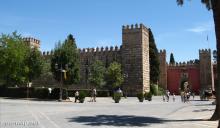
The Alcazar Palace (los Reales Alcazares) is definitly one of the most impressive monuments of Seville. You should not miss it when visiting the city! It is a fortified palace of which the construction was ordered by Abd Al Ramn III in the year 913. The Alcazar palace is considered World Heritage by UNESCO.
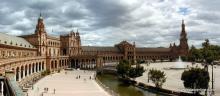
Plaza de España is a semicircular plaza with a diametre of 200 metres which is flanked by two spectacular towers and a bordering lake that are especially worth seeing. Representative of much of the regional architecture, this magnificent construcion is highlighted with polychromatic ceramic tiles.
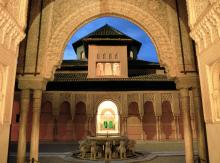
The Alhambra was a palace, a citadel, fortress, and the home of the Nasrid sultans, high government officials, servants of the court and elite soldiers (from the 13th to the 14th century).
Today, it is the most visited site of Spain. The monument is divided into four main areas: the Palaces, the military zone or Alcazaba, the city or Medina and the agricultural estate of the Generalife. All of these areas are surrounded by woods, gardens and orchards.
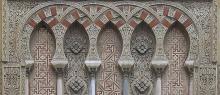
The architecture of the Cordoba Mosque tells the history of a fascinating era which is unique. The mosque was built from 780, on the site of the Visigothic church of St-Vincent, and successively extended by the addition of new naves until 987 when it had its current dimensions.
After the Spanish reconquest, with the newly regained power in Córdoba, the Christians built a gothic cathedral in the heart of the mosque.